Ceramic tile stickers versus vinyl and printed tiles: durability, cost and design comparison
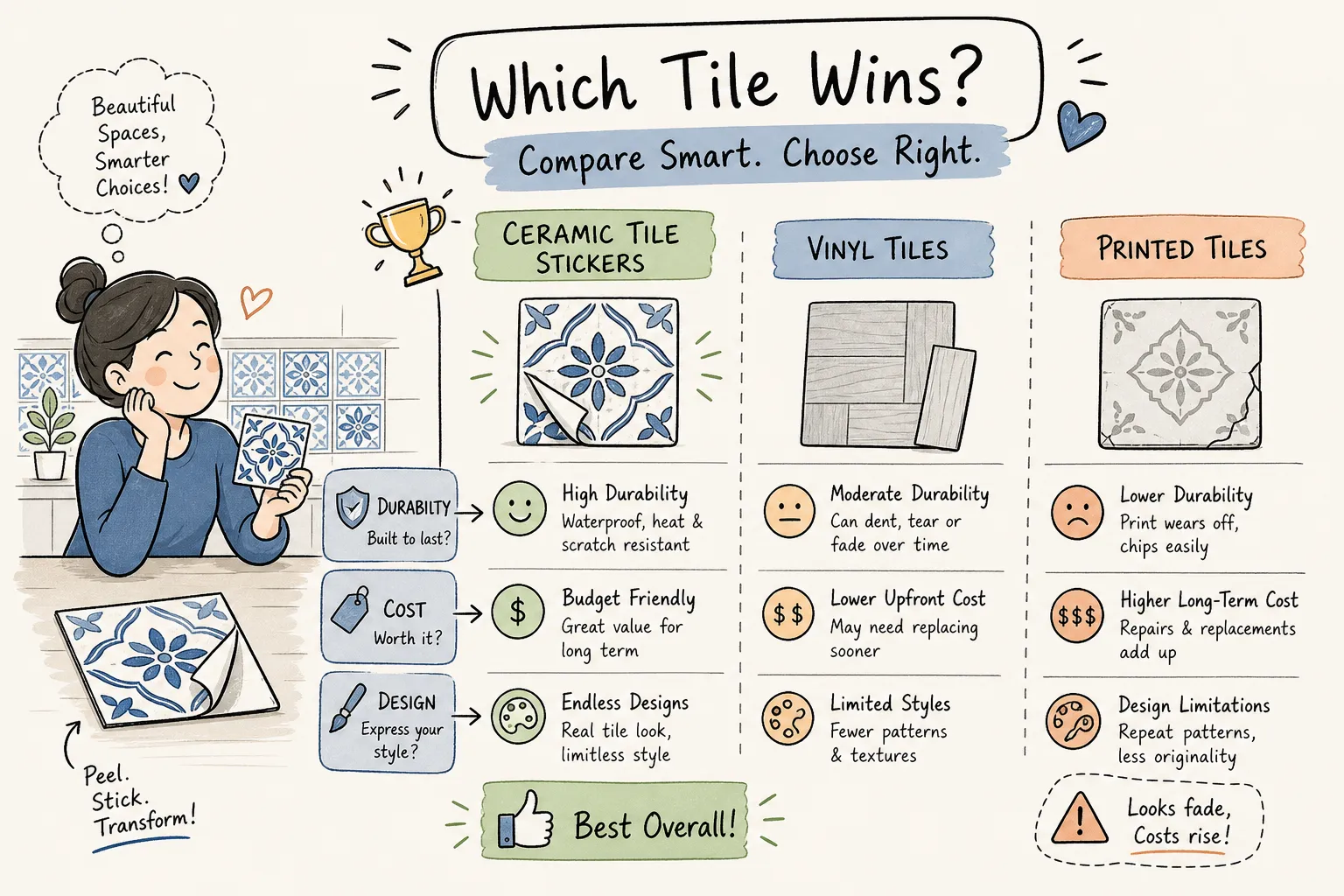
When people search for ceramic tile stickers, they often picture a peel-and-stick vinyl sheet that transforms a dated backsplash in an afternoon. What many do not realise is that the same search term covers three completely different products, each built from different materials, designed for different lifespans, and suited to entirely different budgets and use cases. Choosing the wrong one means either peeling up failed edges within two years or paying factory-tile minimum orders for a design that could have been tested cheaply first.
The three categories are kiln-fired waterslide decals, vinyl peel-and-stick stickers, and screen-printed factory tiles. At Ceramic Decals India, we frequently receive this question from potters, café owners, and interior designers, and the answer is almost never one-size-fits-all. This comparison covers durability, design accuracy, application, and real cost so you can make the right call before spending a rupee.
What separates kiln-fired ceramic decals from vinyl and screen-printed tiles
How kiln-fired waterslide decals work on ceramic surfaces
Kiln-fired waterslide decals are printed onto a release sheet using ceramic toner. To apply one, soak the sheet in warm water until the decal releases from its backing, typically around 30 to 60 seconds depending on the product, then slide it onto a glazed ceramic surface, smooth out air and water, and fire the piece in a kiln at the supplier-specified overglaze temperature, generally in the range of 780°C to 850°C. At that temperature, the ceramic pigments fuse directly into the glaze. The result is not a sticker in any adhesive sense: the image becomes part of the tile itself, as permanent as the original glaze firing.
What vinyl peel-and-stick tile stickers actually are
Self-adhesive tile decals are printed PVC or vinyl sheets, typically 80 to 100 microns thick, with a pressure-sensitive adhesive on one side and a decorative print on the other. Common formats run from 8×8 cm up to 20×20 cm, sold in packs of 8 to 36. No heat, no kiln, and no specialist equipment are required. You apply them directly over existing tiles or smooth walls in an afternoon. They are a surface-level finish, and a genuinely useful one in the right situation, but they are fundamentally different from a fused ceramic surface.
Screen-printed tiles: the traditional production route
Screen-printed and digitally printed ceramic tiles are produced at factory level, glazed and kiln-fired in bulk during manufacture. They carry genuine ceramic durability, but they require high minimum quantities, involve costly design separations for each colour change, and offer no practical customisation once the run begins. For a business testing a new branded tile or an architect sampling a pattern, this route is rarely viable.
Durability head-to-head: ceramic tile stickers vs vinyl and printed tiles
Heat, moisture and dishwasher resistance
Because the pigments in kiln-fired decals are fused into the glaze rather than sitting on top of it, they are highly resistant to commercial dishwasher cycles and continuous steam exposure. Vinyl tile decals, even those marketed as waterproof, carry adhesive seams that fail under prolonged moisture or temperatures above approximately 50°C, a threshold referenced by many thin-film vinyl product specifications. They work acceptably on backsplash walls away from direct flame, but they are not suited to shower interiors, steam-heavy kitchen environments, or any surface that will be submerged or repeatedly saturated.
Food safety and chemical exposure
Kiln-fired overglaze decals can be produced lead-free and cadmium-free, and the finished, fired article can meet FSSAI food-contact requirements when tested at a NABL-accredited laboratory for metal migration. This makes them appropriate for dinnerware, serving tiles, and café countertops, provided the completed tile has been properly tested rather than relying solely on a supplier declaration. Vinyl stickers carry no comparable food-safety pathway. Screen-printed factory tiles meet a manufacturer standard but cannot be customised once produced.
Realistic lifespan for each type
Kiln-fired decals are permanent for the life of the tile. Vinyl and removable tile covers last roughly 2 to 5 years on kitchen backsplashes, and potentially 3 to 5 years on low-moisture bathroom accent walls. Budget vinyl can begin lifting or fading within 6 to 18 months. Screen-printed factory tiles last as long as the tile itself but offer no flexibility if the design needs updating.
Design and colour accuracy of ceramic tile stickers
Pantone and RGB matching in kiln-fired ceramic printing
Kiln-fired ceramic toner printing supports photo-realistic artwork and fine-line detail at high resolution, with RGB and Pantone references used as the starting point for colour conversion. The conversion from a Pantone reference to ceramic toner must account for how pigment chemistry, glaze surface, firing temperature, and kiln atmosphere all affect the final colour, which means the fired physical sample is the definitive reference, not the digital proof. A digital proof accurately establishes artwork position, scale, and general colour direction, but should be understood as a guide rather than a guarantee of the fired result.
At Ceramic Decals India, every order includes complimentary design proofing so customers see and approve artwork before any sheet is printed, locking in colour and layout before cost is committed. Confirm proofing and colour-approval steps with your chosen supplier before placing an order.
What vinyl printing can and cannot replicate
Standard backsplash tile stickers are digitally printed on adhesive film. Colour accuracy is acceptable for decorative geometric or floral patterns, but it is inconsistent for brand-critical Pantone matches. Glossy laminates add some surface depth, but the result reads as flat compared to a fused ceramic finish with its natural light interaction. For purely decorative use, that difference may be tolerable. For hospitality branding or product design, it matters considerably.
Scale, file format and artwork flexibility
Kiln-fired decals accept any vector or high-resolution raster file, giving you full control over artwork placement, scale, and composition. Vinyl suppliers typically work from fixed templates or repeat patterns, which limits layout freedom considerably. Screen-printed factory tiles require costly separations per colour and lock the design into the original run. If you need genuine artwork control, the kiln-fired route is the only one that delivers it, for example, a custom tile sticker sheet in India carrying multiple logo sizes or mixed imagery on a single A4 print, ready to fire at a local studio.
The right material for each space and use case
Kitchens and bathroom backsplashes
For kitchen backsplashes away from gas flames, self-adhesive tile decals offer a practical short-term update, particularly for renters who need a reversible solution. For permanent kitchen tile work, including café pass-throughs, feature walls, and restaurant countertops, kiln-fired decals applied to glazed tiles produce a finish that survives daily cleaning, steam, and grease exposure without lifting edges or fading. The surface behaves exactly like the original tile glaze, because it is fused into it.
Bathrooms, wet areas and shower-adjacent surfaces
Vinyl tile stickers on smooth, dry bathroom walls can last 3 to 5 years in low-moisture conditions. They are not rated for shower interiors or constant water saturation, and the adhesive seams are the first point of failure. Kiln-fired decals on glazed tiles are impervious to moisture and cleaning chemicals once fired. For a bathroom where the finish needs to outlast multiple tenancies or meet a hospitality standard, the two options are not comparable.
Cafés, boutique hotels and commercial interiors
Branded hospitality tiles need food-safe surfaces, repeatable colour accuracy, and longevity that outlasts a refurbishment cycle. Vinyl is not a credible option at this level. Screen-printed factory tiles work in production but require large minimum orders and long lead times. Kiln-fired custom ceramic-look tile stickers allow a café or hotel to test a branded tile design on actual fired ceramic before committing to full production, some suppliers, including Ceramic Decals India, offer single A4 sheet sampling to make this practical. This is where waterslide decal technology genuinely changes the business case for small hospitality operators across India: prototype at low cost, prove the design on an actual fired tile, and scale only when you are ready.
Applying ceramic tile stickers: waterslide soak to kiln-fired finish
Applying a kiln-fired waterslide ceramic decal step by step
The application process is straightforward for anyone working with glazed ceramic surfaces. Follow these steps in order for a clean result.
- Clean and dry the glazed tile surface completely before starting.
- Soak the decal sheet in warm water until it releases from the backing paper, typically around 30 to 60 seconds, though exact timing varies by product.
- Slide the decal onto the tile surface and position it carefully.
- Smooth out air bubbles and excess water using a soft squeegee, working from the centre outward.
- Allow the decal to dry fully before placing the tile in the kiln.
- Fire at the supplier-specified overglaze temperature, confirm the exact schedule with your decal supplier, as the correct range depends on decal type and glaze chemistry.
Suppliers typically provide full firing temperature guidance with each order; confirm this with your chosen vendor before firing. Customers who do not have kiln access can work with local ceramic studios for the firing step, which is a common arrangement for artists and small hospitality buyers alike.
Applying vinyl peel-and-stick stickers
Vinyl application requires no heat and no specialist equipment, but surface preparation determines whether the sticker lasts two years or five. Degrease and dry the surface completely, then mark a level starting line using a spirit level. Peel the backing in sections rather than all at once, smoothing each section from the centre outward with a plastic squeegee. Trim edges against a straightedge with a sharp utility knife, and press all seams firmly with a J-roller. Apply a thin bead of clear silicone at the countertop joint to stop water entering behind the bottom edge.
Which process suits which buyer
Kiln-fired waterslide decals suit potters, ceramic artists, hospitality buyers, and anyone needing a permanent, food-safe result. Vinyl peel-and-stick stickers suit renters, DIY decorators, and short-term makeovers where the finish will be replaced or removed within a few years. The mistake is specifying vinyl for a hospitality kitchen or ordering a factory tile run when a single decal sheet would answer the question.
Cost breakdown: what you actually pay and what you actually get
Upfront cost per tile across the three types
Vinyl peel-and-stick tile sticker packs in India typically cost ₹500 to ₹2,500 for 8 to 36 stickers, working out to approximately ₹15 to ₹50 per tile depending on size and quality. Budget sheets run as low as ₹88 to ₹299 per pack. Kiln-fired waterslide decal sheets are priced in scalable tiers from a single A4 sheet upward, with volume discounts and GST-compliant invoicing for business orders. Depending on layout, a single A4 sheet can carry multiple small decals, which brings the per-decal cost down meaningfully at even modest quantities.
The no-minimum-order advantage for sampling
One of the most practical differences in this comparison is order flexibility. Some kiln-fired decal suppliers, including Ceramic Decals India, offer no minimum order quantities, which means a café testing a new logo tile or an architect sampling a decorative pattern pays only for what they need. Vinyl sticker packs come in fixed quantities regardless of how many tiles you actually want to cover. Factory screen-printed tiles often require hundreds of units before production is viable, making small-scale testing completely impractical.
Longevity-adjusted value and delivery
When you divide cost by expected lifespan, kiln-fired decals are consistently more cost-effective for permanent or commercial applications. A vinyl sticker at ₹40 per tile replaced every three years costs more over a decade than a kiln-fired finish applied once. For purely short-term or rental decoration, vinyl remains the more accessible option. Confirm dispatch timelines directly with your chosen supplier; for commercial buyers on a deadline, lead time is worth clarifying upfront.
Which ceramic tile stickers are right for your project?
The right choice depends entirely on your surface, your timeline, and how long the finish needs to last. Vinyl peel-and-stick stickers are the honest choice for temporary updates, rental spaces, and low-moisture accent walls. For kitchens, cafés, bathrooms, and hospitality interiors where food safety, dishwasher resistance, and permanent colour accuracy matter, kiln-fired waterslide ceramic tile stickers are in a different category altogether.
The barrier to testing kiln-fired ceramic decals has dropped considerably for buyers across India. With flexible order quantities, complimentary design proofing available from specialist suppliers, and the ability to fire at a local studio if you lack kiln access, the comparison between vinyl and kiln-fired is no longer simply about price. It is a choice between temporary and permanent.
If you have a custom ceramic tile stickers project in mind, whether a single prototype or a full hospitality run, get in touch with the team at Ceramic Decals India to request a sample or design proof. The team will confirm colour, layout, and firing specifications before a single sheet goes to print.