How to choose and apply dishwasher-safe stickers for mugs, plates and tiles
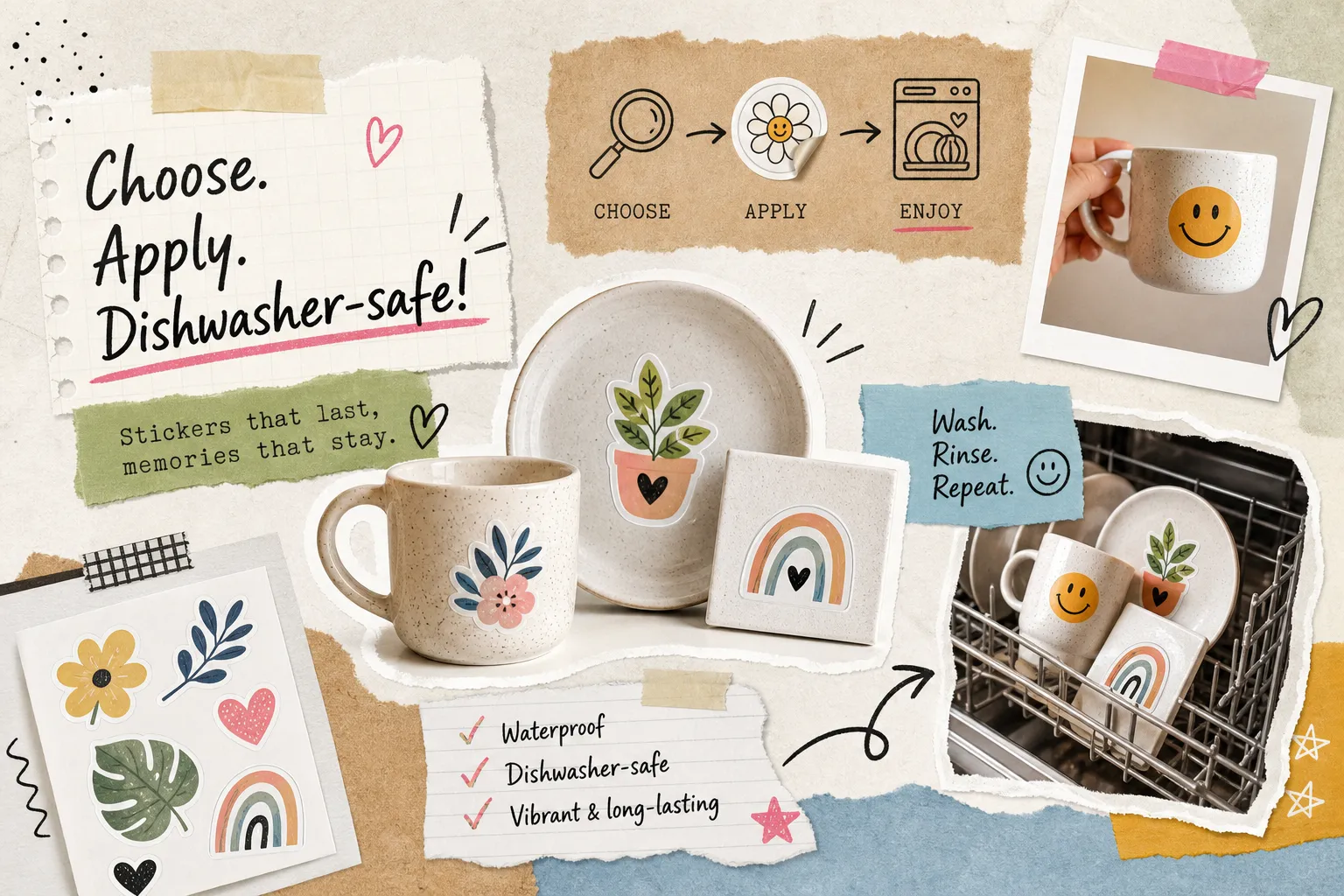
If you are searching for stickers for dishwasher use, you are likely facing one of two situations. The first is practical: you want a label or decal on a mug, bottle, or plate to survive regular washing without peeling, fading, or leaving a sticky residue behind. The second is a niche case: you want a sticker for the dishwasher panel itself, or a marker to indicate which items are dishwasher-safe. This article focuses on the first and far more common question, because that is where the real decision-making happens.
The honest framing is this: not all stickers survive the dishwasher, and even the best waterproof vinyl or laminated sticker has a lifespan measured in cycles, not years. For a personal mug washed gently a few times a week, the right sticker with proper sealing works well enough. For commercial settings such as café cups, hotel dinnerware, or corporate gifting, kiln-fired decoration permanently fused into the glaze is far more durable than any pressure-sensitive sticker. This article covers the full spectrum, from understanding materials and DIY sealing methods to permanent ceramic alternatives, so you can make the right call for your specific situation.
Stickers for dishwasher use: what actually makes a sticker dishwasher-safe
The material stack that determines durability
The term "dishwasher-safe" applies to the entire construction of a sticker, not just the face material. A sticker is a stack: face material, ink, protective coating, adhesive, and the surface it is applied to. Every layer matters. Waterproof vinyl or PVC is the most common face material for dishwasher-rated stickers; it does not absorb water, stays dimensionally stable, and resists normal dishwasher heat when laminated. Polyester or PET offers stronger heat resistance and performs well under repeated exposure, though it is less flexible on curved surfaces like mugs. Ordinary paper, even when coated, absorbs water and swells, leading to bubbling, ink damage, and edge lifting. No coating changes that fundamental behaviour reliably enough for regular dishwasher use.
The material name alone is not a guarantee. A label must explicitly state that it is dishwasher-safe, not just waterproof. Waterproof means it resists liquid penetration; dishwasher-safe means it has been tested against the combined effect of heat, alkaline detergent, and high-pressure spray across repeated cycles. These are meaningfully different claims.
Adhesive type: the part most buyers overlook
Adhesive failure is a common reason stickers do not survive dishwasher use, yet buyers rarely check this specification before purchasing. Permanent, high-tack acrylic adhesive is the preferred type: it maintains its bond through moisture, temperature cycling, and detergent exposure far better than alternatives. Rubber-based permanent adhesives soften under heat and moisture, which encourages edge lift, especially after repeated cycles. Removable adhesives are not designed for prolonged exposure to hot water and detergent; they will peel. Even a waterproof face material paired with the wrong adhesive underneath will fail at the edges within a handful of washes. Buyers should verify the adhesive specification, preferably permanent acrylic, on the product listing before purchasing.
Surface preparation matters as much as adhesive type. Glazed ceramic, glass, and stainless steel are ideal application surfaces because they are smooth and nonporous. Textured, silicone, or porous surfaces give the adhesive far less to grip and accelerate failure regardless of how good the sticker is.
What to check when buying dishwasher-proof labels in India
When shopping for ready-made dishwasher-friendly decals or labels in India, run through this checklist before adding anything to your cart. Look for both "waterproof" and "dishwasher-safe" explicitly stated on the listing. Choose vinyl or PET face stock, not paper. Confirm permanent acrylic adhesive. Check whether the rating specifies top-rack use, which is the cooler and less aggressive part of the machine. Read the application and cure instructions: many quality labels require 24 hours of cure time after application before the first wash cycle, and skipping this step is a common reason for early failure.
Personalised vinyl name labels, laminated BOPP drinkware stickers, and custom-cut PET stickers with gloss UV laminate are all available from Indian sellers and international platforms shipping to India. The specifications vary significantly between sellers, so check each product page rather than assuming the category description applies to the specific item.
DIY sealing tips for stickers for dishwasher use
The laminate-and-seal approach
If you are making your own stickers, the most reliable DIY method is waterproof printable vinyl combined with a clear self-adhesive cold laminate. Print your design on waterproof vinyl compatible with your printer; pigment or laser inks resist water better than standard dye inks. Allow the printed sheet to dry fully, at least 24 hours for heavily inked designs, before doing anything else. Then apply your clear laminate slightly larger than the printed area, smoothing it from one edge outward with a plastic card or squeegee to work out any bubbles.
The critical step is edge sealing. Leave a transparent border of roughly 2 to 3 mm around every sticker so the laminate extends beyond the design on all sides. This is where dishwasher water finds its way in first: an exposed edge is an open door. Cut the stickers only after laminating, not before. Clean the application surface with isopropyl alcohol, allow it to dry completely (since grease or fingerprints prevent proper adhesion), apply the sticker from the centre outward, and burnish the edges firmly. Then allow 24 to 72 hours of adhesive cure before the first wash cycle.
Spray sealants and epoxy: where they fit and where they fall short
Clear acrylic spray sealant is easier to apply over irregular shapes and adds a layer of water resistance, but it is less reliable than a laminate for dishwasher use. Thin spray films develop edge wear faster, and the cut edges of the sticker remain the weakest point. Apply several thin coats rather than one heavy coat, allowing drying time between each, and cure fully before washing. Two-part epoxy resin offers the highest physical barrier of any DIY finish and the best abrasion resistance, but it is harder to apply evenly, takes about 72 hours to cure properly, and can yellow over time.
None of these finishes guarantee permanent dishwasher durability. For items that must stay presentable over time, hand-washing is still the most reliable long-term approach. If dishwasher use is unavoidable, use the top rack, skip the heated drying cycle, and avoid placing the sticker where the spray arm hits directly.
Realistic lifespan: what to expect wash after wash
How heat, detergent, and spray pressure damage stickers over time
Dishwasher damage is cumulative and works through three mechanisms simultaneously. Beginning with heat: adhesives soften and edges begin to lift, letting water penetrate beneath the sticker. Commercial dishwashers in Indian cafés and hotels typically run a wash cycle at 55 to 65°C, followed by a final rinse at 80 to 90°C, based on industry hospitality equipment specifications. Standard vinyl sticker adhesives have an upper service limit of around 70 to 90°C depending on their formulation, which means the final rinse alone pushes many adhesives to or beyond their rated limit. Strongly alkaline dishwasher detergents attack ink and protective coatings independently of temperature. Then the spray pressure compounds the wear at sticker edges with every cycle.
Early failure signs are edge lifting, loss of gloss, and colour fading. For lesser materials under harsh conditions, these can start appearing after 10 to 20 cycles. Better vinyl stickers with proper laminates last longer under gentler conditions, but the degradation is an eventual certainty rather than a possibility.
When a sticker is acceptable and when it is not
For personal use on a home mug washed on a gentle top-rack cycle a few times per week, a quality vinyl sticker sealed with a clear laminate is a practical and low-cost solution. The sticker will eventually show wear, but for personal use that is an acceptable trade-off. For commercial use, the calculation changes entirely. A café cup goes through a commercial dishwasher multiple times daily. A hotel's dinnerware service runs hundreds of cycles per month. Degrading edges and lifting print in these settings are not just an aesthetic problem; they are a food safety concern, because a separating sticker edge in a commercial kitchen is a contamination risk. The fundamental limitation of pressure-sensitive adhesives, in other words, quickly becomes a business problem rather than a cosmetic one, and that is what drives commercial operators towards permanently fired decoration.
Why kiln-fired ceramic decals solve what stickers fundamentally cannot
The difference between a sticker and a waterslide ceramic decal
A waterslide ceramic decal is a completely different technology from a sticker, and the distinction matters enormously. A sticker sits on top of the glaze via adhesive: it is attached to the surface, not part of it. A ceramic decal is transferred onto the glazed surface and then fired in a kiln at temperatures between 780 and 850°C for overglaze applications. During firing, the ceramic toner fuses permanently into the glaze layer. The result is not a coating that can peel; it is part of the ceramic surface itself. There is no adhesive to soften, no edge to lift, and no film to degrade.
Industry and supplier testing indicates that kiln-fired decoration typically withstands 500 to 800 commercial dishwasher cycles before showing any visible degradation, though actual performance varies with firing schedule, glaze type, detergent chemistry, and wash conditions. Even the best dishwasher-safe cup stickers begin to fail in far fewer cycles. The two technologies are not comparable on a spectrum of quality; they operate on entirely different principles.
Food safety and durability that no sticker can replicate
Many kiln-fired ceramic decals are formulated with food-safe, lead-free, cadmium-free ceramic inks, though finished-article safety depends on correct firing and should ideally be verified through migration testing of the final fired product in line with FSSAI and IS 15495 guidance. Once correctly fired, the decoration withstands commercial dishwasher conditions through hundreds of cycles without fading, peeling, or lifting. For the Indian market, food-contact ceramics must not transfer substances that endanger health or adversely affect food composition; a properly kiln-fired ceramic decal from quality inks meets this requirement in a way that a degrading adhesive sticker cannot. Buyers should request confirmation of ink formulation and, where feasible, NABL-accredited test reports for finished articles rather than relying solely on ink-label claims.
Ceramic Decals India is a dedicated ceramic decal printing service that produces high-resolution overglaze decals using professional ceramic toner technology. The company states that its inks are lead-free, cadmium-free, and FSSAI-compatible, with full RGB and Pantone colour matching for photo-realistic, brand-accurate output. For businesses where branding consistency and food safety are non-negotiable, a permanently fired ceramic decal is not simply an upgrade from a sticker but a replacement of the concept entirely.
How to choose and apply ceramic decals for mugs, plates, and tiles
Choosing between overglaze and underglaze decals
For most cafés, hotels, and corporate gifting applications using pre-glazed ceramic blanks, overglaze decals are the correct and accessible choice. Overglaze decals are applied over the existing fired glaze and then refired at a lower temperature, around 800 to 850°C. This works with commercially available glazed ceramics without requiring any change to the blank's production process.
Underglaze decals go beneath the glaze and require an additional glaze coat followed by a higher-temperature firing, which is typically used in production pottery environments rather than by decorators working with finished ware. Unless you are operating in a studio that controls the full production process, overglaze is the practical route.
Applying and firing decals: the practical process
The application process is straightforward once you have done it once. Clean the glazed surface thoroughly with isopropyl alcohol and allow it to dry completely, since grease or fingerprints prevent proper adhesion. Trim the decal to remove excess clear film, leaving just a small border around the design. Soak the trimmed decal in lukewarm water for approximately 30 seconds, until the paper backing becomes thoroughly wet and the image begins to slide. Then position it on the ceramic surface and gently slide the backing paper out from underneath, leaving the printed image in place.
While the decal is still wet, adjust its position if needed, then smooth out water and air bubbles from the centre outward using a soft squeegee or your fingertip. Blot the surface with a lint-free cloth and allow the piece to dry completely before loading the kiln. Reputable suppliers typically include firing temperature guidance with each order; confirm this with your supplier before you begin, as the correct schedule varies with decal formulation and can affect both colour accuracy and food-safety compliance.
Where ceramic decals make practical sense on tiles
Decorative wall tiles, feature panels, and ceramic signage use the same kiln-fired decal technology, though dishwasher durability is rarely the relevant specification for tiles. The key performance criteria for tile decals are print durability under regular light cleaning and UV exposure in commercial interiors. The same fired-in permanence that makes ceramic decals durable on mugs through hundreds of dishwasher cycles makes them resistant to cleaning agents and fading on walls, which is why architects and hospitality specifiers increasingly use them for custom interior applications alongside tableware projects.
Use cases and getting started with ceramic decals in India
Who benefits most from permanent ceramic decoration
The commercial use cases where stickers fall short most visibly include the following.
- Specialty cafés and coffee shops:branded espresso cups and latte mugs go through commercial dishwashers multiple times daily. A vinyl sticker will not survive a week of this. Kiln-fired decals keep the logo sharp and the surface food-safe through hundreds of washes, with no reprinting or replacing worn items mid-season.
- Boutique hotels and resorts:custom dinnerware and in-room ceramic amenities represent brand identity at every guest touchpoint. Permanent decoration maintains consistency across a property's lifetime, without the progressive degradation that stickers show within weeks of commercial service.
- Corporate gifting:premium branded mugs and ceramic tiles as gifts must look good after repeated use, not just on the day they are received. Kiln-fired branding delivers a quality finish that vinyl stickers cannot match, and it signals the quality of the gift rather than undermining it.
What Ceramic Decals India offers for prototype and production runs
One practical barrier to adopting ceramic decals has historically been minimum order quantities. Ceramic Decals India reports no minimum order requirement, which means a café owner can start with a single A4 sheet to test a design on two or three mugs before committing to a production run. The company also offers design proofing so that colour accuracy and resolution are confirmed before any sheet is produced. Buyers should verify current terms, turnaround times, and proofing arrangements directly with the team.
Scalable pricing tiers with GST invoicing are reported to serve both individual studio artists and commercial buyers ordering at volume, with pan-India delivery quoted at 3 to 5 business days. For brands with strict colour standards, full RGB and Pantone colour matching reduces the colour-accuracy uncertainty that DIY sticker printing, and even many commercial print services, can introduce. Get in touch with the Ceramic Decals India team to confirm service details and request a sample.
Conclusion
The decision is straightforward once you are clear about the use case. For personal stickers for dishwasher use on a home mug washed gently a few times per week, a quality waterproof vinyl sticker with a sealed laminate edge is a reasonable, low-cost solution. Prepare the surface properly, cure the adhesive fully, use the top rack, and the sticker will deliver a serviceable number of cycles before it needs replacing.
For commercial use, branded products, or anything where dishwasher durability and food safety are genuinely non-negotiable, stickers will eventually let you down. The degradation is inevitable; in a commercial kitchen it can arrive within days rather than months. Kiln-fired waterslide ceramic decals are not simply a premium version of a sticker, they are a fundamentally different category where the decoration fuses into the glaze and stays there through hundreds of commercial wash cycles without peeling, lifting, or fading. If you need dishwasher-safe cup stickers or a more permanent solution for mugs, plates, or tiles, contact the Ceramic Decals India team to discuss your requirements and request a digital proof.