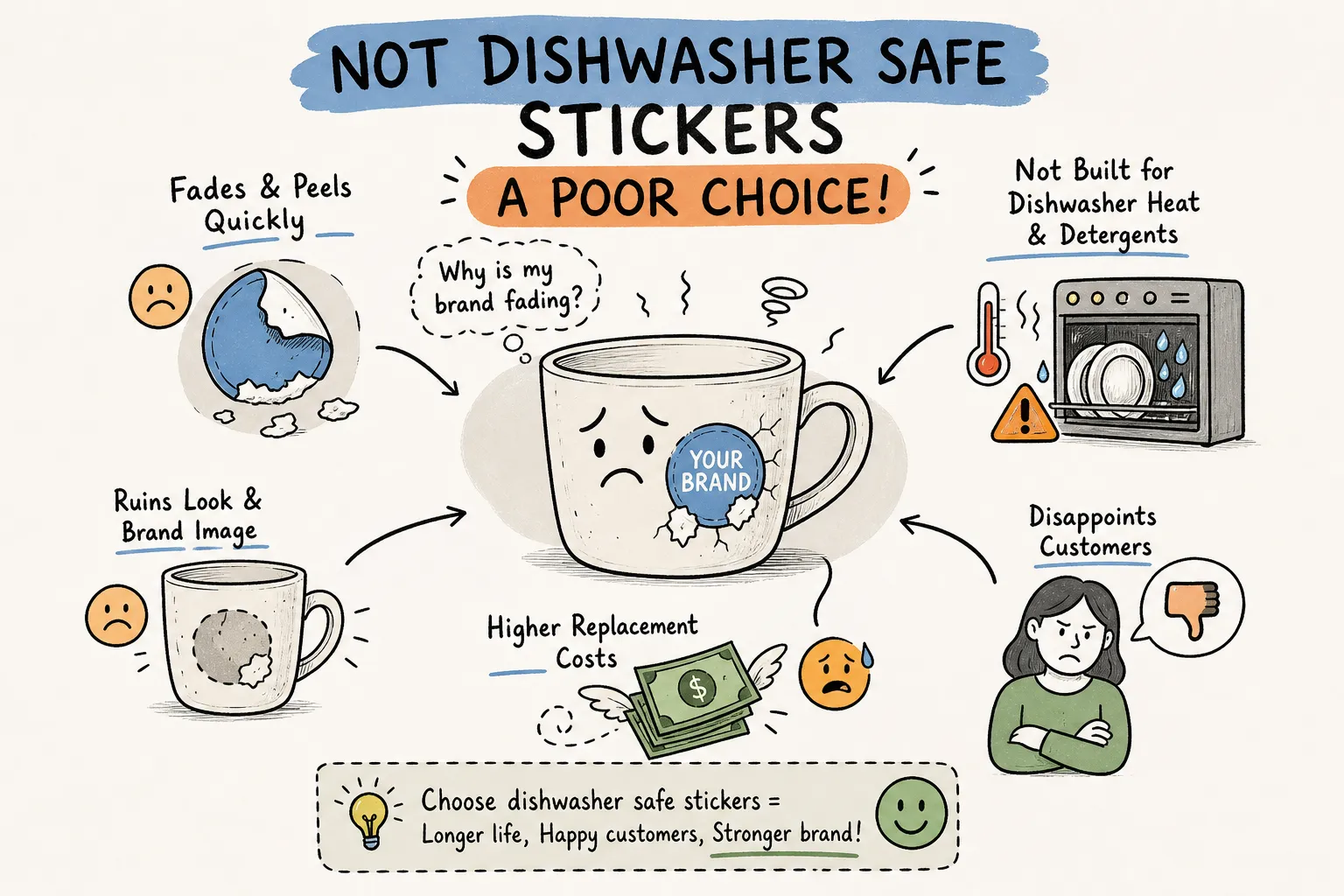
A café owner in Bengaluru applies freshly printed die-cut vinyl stickers to 200 branded espresso cups. The branding looks sharp on day one. By the fortieth commercial wash cycle, the logos are peeling at the corners, the colours have dulled, and the mugs look worse than if they had no branding at all. The natural reaction is to find a "better sticker." The real problem, however, is that most adhesive stickers are not structurally suited to what a commercial dishwasher does to a glazed ceramic surface. A sticker labelled "not dishwasher safe" is not a minor inconvenience to engineer around with a clear coat and a prayer. It is a warning about a fundamental materials mismatch, and this article explains exactly why.
Whether you manage branded crockery for a café, a boutique hotel, or a corporate gifting operation, understanding why adhesive labels fail on ceramics will save you money, protect your brand, and keep you on the right side of food-safety compliance. It will also help you identify when a permanent alternative makes more practical sense than yet another sticker replacement cycle.
Why stickers end up on pottery and branded crockery at all
The appeal is obvious. Adhesive labels require no kiln, no firing equipment, and no specialist knowledge. A café launching a seasonal menu can order custom vinyl stickers, apply them in an afternoon, and have branded mugs on the counter by evening. For a potter testing a new design before committing to a full production run, a sticker feels like the logical low-risk option. At a per-unit cost of roughly ₹7 to ₹15 for quality laminated vinyl, the upfront spend also looks very reasonable compared to other branding methods.
The "not dishwasher safe" label on a sticker packet, though, is not a conservative disclaimer written by a cautious legal team. It is an honest material specification. It means that one or more components of that sticker, whether the substrate, the ink system, or the adhesive, will degrade under the specific combination of conditions inside a dishwasher: sustained heat between 60 and 88°C in a commercial machine, alkaline enzymatic detergent, high-pressure water jets, and a drying phase that can push surface temperatures even higher. These are not gentle conditions, and they do not act one at a time.
What actually happens to a sticker inside a dishwasher
Heat, detergent, and water pressure act simultaneously inside a dishwasher rather than in sequence. Heat softens the adhesive polymer, lowering its shear and peel strength, while also creating differential thermal expansion between the sticker film and the ceramic glaze underneath. Alkaline detergent attacks exposed ink chemistry and adhesive bonds. High-pressure jets target any imperfect edge with mechanical force. This is why no spray-on clear coat or polyurethane sealant reliably converts a standard sticker into a dishwasher-durable label: you can seal the surface, but you cannot seal every microscopic edge under commercial wash conditions.
The failure sequence is cumulative and predictable. Edge lift typically begins early, often at a corner where surface contamination or application pressure was slightly inconsistent. Once water and detergent enter that gap, the debonded zone expands with each subsequent cycle. Under harsher commercial conditions, visible separation can appear within 10 to 15 cycles; well-specified constructions may last considerably longer under domestic top-rack use, but the progression follows the same pattern. Colour fade and delamination, where the laminate separates from the face film or the ink layer, typically run in parallel with the peeling. This is not a single-event failure. It is a progressive material breakdown driven by cumulative thermal, chemical, and mechanical exposure.
Even laminated vinyl, the best-performing adhesive label material available, depends on four things working together: a dishwasher-rated adhesive, a protected UV-cured or pigment-based ink system, a properly bonded laminate, and a fully sealed edge. Most off-the-shelf stickers sold as "waterproof" are designed for outdoor use or bottle labelling, not for repeated commercial cycles at 65 to 88°C with enzymatic detergents. In one published product trial, a well-specified laminated label showed no visible peeling after 50 top-rack domestic cycles under controlled conditions; under commercial dishwasher conditions, edge lifting can appear within 10 to 15 cycles for labels not built to that specification.
Safety and brand damage you probably haven't factored in
A sticker applied to the interior or rim area of a cup is a food-contact surface. Many pressure-sensitive adhesives and generic inks are not specifically certified for sustained food contact, nor for the chemical environment of a commercial dishwasher. As the label degrades, adhesive residue and ink components can transfer to the ceramic surface and, from there, to food or beverages. Under FSSAI's food-contact material requirements, any material likely to contact food must be demonstrably suitable for that use and must not migrate constituents that could harm health. Standard adhesive labels frequently do not include material specification sheets, migration testing data, or NABL laboratory certification, request these documents before ordering, as many marketplace listings omit them unless specifically asked. For cafés and hotels operating under FSSAI licences, this is a real regulatory risk, not a theoretical one.
The commercial damage is equally concrete. A branded mug with a curling, faded sticker communicates exactly the opposite of what a premium café or boutique hotel intends. Every customer who picks up that cup receives a signal about how much the business values its own presentation. When you account for the full cost of a sticker replacement programme at 200 cups, including reprinting, reapplication labour, downtime, and stock wastage across multiple replacement cycles, the apparent cost advantage of stickers over permanent branding solutions shrinks considerably and often disappears entirely.
Why kiln-fired ceramic decals are the permanent alternative
A waterslide ceramic decal works on an entirely different physical principle to an adhesive sticker. The design is printed with ceramic toner onto a water-release film. You soak the film, slide the decal onto the glazed ceramic surface, and fire the piece in a kiln at 750 to 850°C. The design fuses into the glaze. There is no adhesive layer, no ink film sitting on the surface exposed to detergent, and no edge to lift. The result is flush with the ceramic, physically bonded to the glaze, and food-safe by nature of the firing process.
Consider what this can look like in practice. A specialty café in Bengaluru was replacing die-cut vinyl stickers on 200 branded espresso cups every 30 to 40 washes. The per-cup branding cost was around ₹10 to ₹12, which looked affordable until multiplied by the replacement frequency. As a trial, they ordered a single A4 sheet of custom waterslide decals, no minimum order was required, and a digital proof was provided before any print was run. After firing, the cups went through more than 60 consecutive commercial dishwasher cycles with no reported degradation in the logo or colour, and the replacement cycle was eliminated. Results will vary depending on kiln conditions and dishwasher specification; the sensible step is to run your own sample test before committing to a full production order.
Ceramic Decals India is a dedicated ceramic decal printing service, and both individual studio potters and commercial kitchens use the same service for a few practical reasons.
On the food-safety and durability side: decals are produced lead-free and cadmium-free, and the kiln-firing process is compatible with FSSAI food-contact requirements. The service supports full RGB and Pantone colour matching with complimentary digital proofing before printing, so what you see on screen is what gets fired onto your piece. For specific cycle-durability figures and conformity certificates, contact the team directly and request the relevant documentation.
On the ordering and logistics side: there is no minimum order, so a single A4 sheet is accepted, making prototyping and sampling genuinely low-risk. Scalable pricing with volume discounts and GST invoicing handles commercial buyers, while pan-India delivery keeps turnaround practical. To get a proof for your design, get in touch with the team at Ceramic Decals India.
If a sticker is still your only option right now: what to look for
Some applications genuinely require an adhesive label. Temporary allergen identification, batch tracking, or non-permanent labelling for retail stock are all legitimate use cases. If you are in this position, specify the following before ordering:
- A laminated vinyl or clear polyester substrate
- A permanent high-tack acrylic adhesive explicitly rated for moisture and heat exposure
- UV-cured or pigment-based printing rather than dye-based inkjet
- Manufacturer confirmation of durability across repeated dishwasher cycles, not just a generic "waterproof" claim
Allow at least 24 hours of adhesive curing time before the first wash, and use the top rack to reduce jet pressure and peak heat exposure.
For verified dishwasher-safe labels in India, Amazon India marketplace sellers offer personalised waterproof name labels at roughly ₹3 to ₹10 per label for small quantities. For bulk custom orders, suppliers on IndiaMART, including those in Vadodara, Delhi, and Ahmedabad, offer laminated polyester or vinyl labels from approximately ₹0.50 to ₹6 per piece depending on material, size, and quantity. Before ordering in volume, request a material specification sheet covering substrate type, adhesive chemistry, operating temperature range, and the number of dishwasher cycles tested. For commercial kitchen use, also request food-contact safety documentation. "Waterproof" and "dishwasher-safe" are not the same claim, and the distinction matters when you are putting labels on food-contact surfaces.
Even correctly specified dishwasher-safe stickers are not equivalent to a fused ceramic surface. They will extend the failure point, not eliminate it. Well-specified laminated vinyl labels can show strong performance under domestic top-rack conditions, but commercial conditions, with higher temperatures and harsher detergents, will typically shorten that lifespan.
The practical verdict
Stickers labelled "not dishwasher safe" on pottery and branded crockery present a problem that better application technique or a clear-coat spray will not solve. The failure modes, edge lift, colour fade, delamination, and adhesive transfer, are built into the material chemistry and the physics of what a commercial dishwasher does. For temporary labelling or allergen identification, a correctly specified laminated vinyl label with a rated adhesive is the pragmatic choice. For branded crockery that goes through regular machine washing, the sticker replacement cycle is an ongoing cost with no exit unless you change the branding method entirely.
Kiln-fired waterslide ceramic decals address the problem at the source. The design becomes part of the ceramic surface, physically bonded to the glaze, food-safe by nature of the firing process, and built to withstand commercial dishwasher conditions over the long term. With no minimum order, complimentary proofing, and delivery across India, the barrier to running a trial is genuinely low. Order a single sample sheet, apply it to one piece, fire it, and run it through 20 commercial dishwasher cycles. The evidence from that test will guide your decision far better than any specification sheet alone.