How to Apply Ceramic Tile Stickers for a Durable, Professional Finish
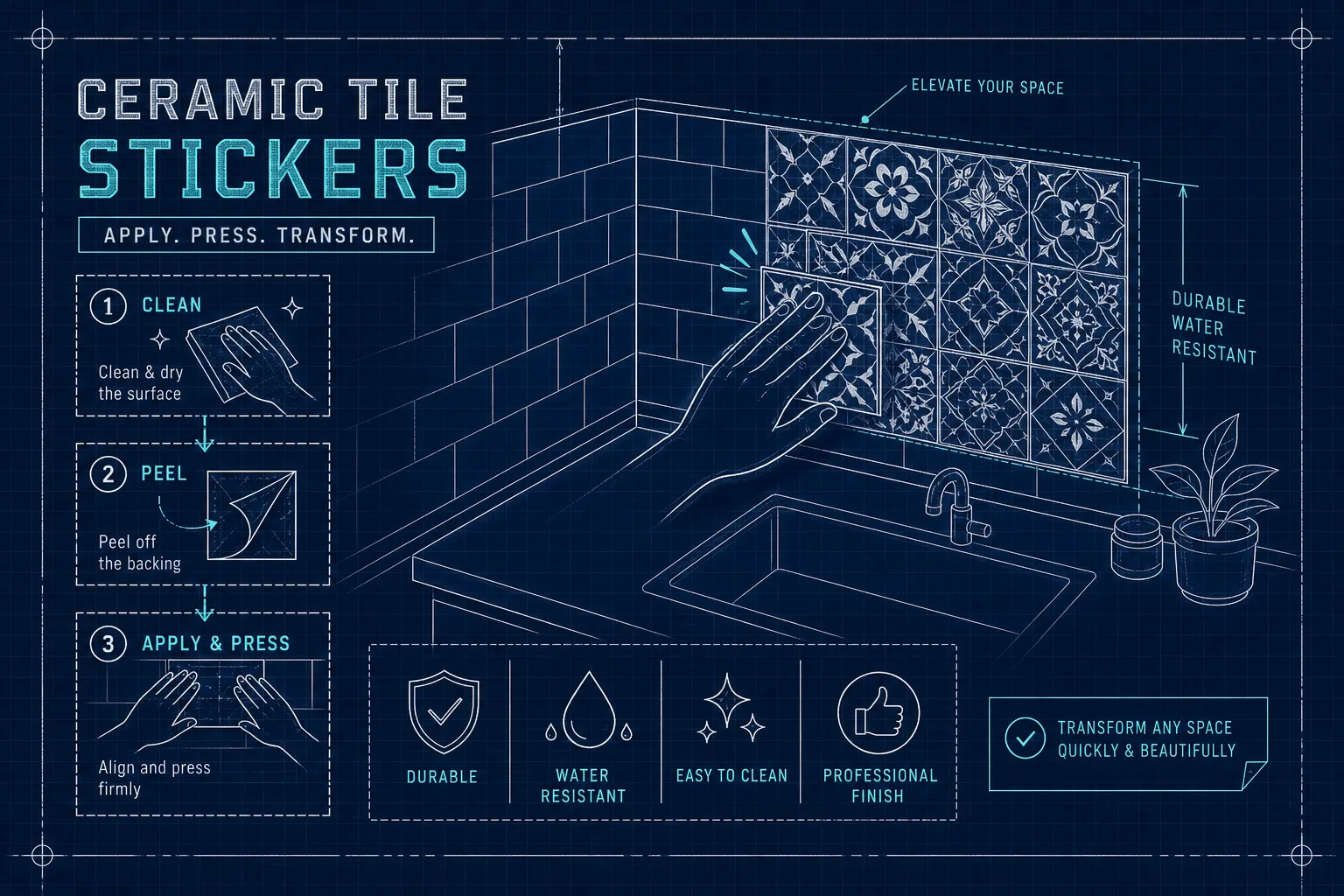
Retiling a kitchen or bathroom is expensive, disruptive, and permanent. You're looking at days of demolition, a mess that spreads through the house, and a bill that can easily reach several tens of thousands of rupees depending on scope and materials. Ceramic tile stickers solve all three problems, but only if you pick the right type and apply them correctly.
Here's what most buyers don't realise: the phrase "ceramic tile sticker" actually describes two completely different products. The first is a temporary peel-and-stick vinyl decal you apply over your existing tiles. The second is a kiln-fired waterslide decal, the kind that fuses permanently into the glaze and is used by potters, cafés, and interior designers for work that has to last. Confusing the two leads to real problems: wrong expectations, premature failure, or spending money on a solution that simply isn't built for your application. This article closes that gap so you can make the right call from the start.
The two types of ceramic tile stickers, and why the difference matters
What peel-and-stick vinyl tile stickers are
Self-adhesive vinyl tile stickers are thin PVC or laminated sheets, pre-cut to standard tile dimensions, with a pressure-sensitive adhesive backing. They sit on top of your existing tiles rather than bonding into the glaze. Common formats include geometric, Moroccan, subway, and solid-colour designs. Their core appeal is straightforward: no tools, no mess, and no permanence. On Amazon India and Flipkart, these are widely available from around ₹350 to ₹1,500 per pack, with budget options at the lower end and larger surface-area sets reaching the higher figure.
What waterslide ceramic decals are
Waterslide ceramic decals are a fundamentally different product. They are printed designs on a water-soluble release film. You soak the sheet, slide the design onto a glazed ceramic surface, and fire it in a kiln at 750, 850°C. The ceramic toner fuses directly into the glaze, becoming part of the tile or ceramic piece permanently. This is precisely what Ceramic Decals India specialises in: high-resolution, overglaze prints that are supplied as lead-free and cadmium-free, and are stated by the supplier to survive 500-plus commercial dishwasher cycles without fading or peeling. Readers should request the relevant test certificates directly from the supplier to verify these claims for their specific application.
Choosing ceramic tile stickers for kitchens and bathrooms
Peel-and-stick vinyl is the right choice for renters, temporary refreshes, and low-budget DIY upgrades where permanence isn't the point. Kiln-fired decals are the right choice for branded café mugs, bespoke tile installations, hospitality dinnerware, and any project where durability and food safety are non-negotiable. This isn't a verdict; it's a decision tree. Both products have a genuine place. The mistake is using one where the other is needed.
Where tile stickers and decals work best
Kitchen backsplashes and feature walls
Kitchen backsplashes are the most popular application for peel-and-stick stickers, and for good reason. The surfaces are large, flat, and relatively accessible, with lower moisture exposure than a shower. The critical caveat for gas cooktops: standard vinyl softens at around 60°C and must be installed at least 30 cm from any burner. Some products are rated to 110°C, but none are safe near direct flame. If the wall surface becomes too hot to hold your hand against comfortably during cooking, it's too hot for vinyl. Kitchen backsplash stickers of the peel-and-stick variety work best on smooth, sealed tiles well away from heat sources.
Bathrooms, wet walls, and near-shower areas
Bathroom wall tiles and low-splash zones work reasonably well with laminated, waterproof-rated sticker products. The challenge is constant steam, repeated soaking, and high-pressure water, all of which attack adhesive bonds over time. Use laminated products rated for wet areas on dry bathroom walls. Avoid placing any peel-and-stick product inside a shower enclosure; even those labelled "waterproof" tend to develop lifted edges under continuous steam. Floor applications in wet areas are especially risky: they face abrasion, standing water, and the added danger of becoming slippery when wet.
Cafés, hotels, and commercial interiors
Commercial settings demand brand consistency, food safety, and the ability to withstand aggressive cleaning schedules that would destroy any vinyl product within months. Branded espresso cups, decorative feature tiles, hotel bathroom amenity ceramics, and café wall panels all benefit from a permanent solution. This is where kiln-fired waterslide ceramic decals are the only practical answer. A peeling sticker on a café mug or a lifting decal in a hotel bathroom reflects directly on the brand, and vinyl, by its nature, cannot hold up to that level of daily commercial use over time.
Picking the right size, design, and colour
Standard sizes and pack formats sold in India
The most common sticker sizes available online in India are 10 × 10 cm, 15 × 15 cm, and 20 × 20 cm. A 48-piece pack of 15 × 15 cm stickers covers roughly 1.08 sq m; a 30-piece pack of 20 × 20 cm covers about 1.20 sq m. Use this simple formula to calculate your order: measure the area in square metres, divide by the coverage per pack, then add 15% for cuts, alignment wastage, and replacements. That buffer matters; you'll almost certainly need it for edges, corners, and any stickers damaged during installation.
Colour matching and design placement
Before committing to a full purchase, order a sample pack or single sheet and hold it against your existing grout colour and tile tone in natural light. Online product photos are rarely accurate enough for colour-critical decisions. For waterslide ceramic decals, Ceramic Decals India offers full RGB and Pantone colour matching with a digital proof before any production begins, which eliminates the guesswork entirely. On design placement, always centre patterns optically rather than mathematically, and start from the most visible focal point, usually directly above the stove or sink, working outward from there.
What to check before buying vinyl tile stickers online
Many online listings use the term "ceramic tile sticker" to describe a vinyl product applied over ceramic; the sticker itself is PVC, not ceramic. Before buying, verify the number of stickers per pack against the stated coverage, confirm the adhesive type and surface compatibility, and check the heat and moisture resistance rating against your actual installation environment. Also look for removable tile decals carefully, many "removable" products become significantly less cooperative after a year or two on the wall, leaving adhesive residue that is difficult to clear without damaging the tile surface beneath.
How to apply ceramic tile stickers step by step
Surface preparation: the step that decides everything
Surface preparation determines whether your installation lasts two years or two months. Degrease the tiles thoroughly with a suitable cleaner, rinse, and allow them to dry completely. Then wipe the surface with rubbing alcohol on a clean cloth to remove any lingering oils. If the surface is porous, dusty, or chalky, apply a compatible acrylic or tile bonding primer and allow it to cure fully before proceeding. This preparation step applies equally to vinyl sticker installations and to preparing a glazed surface for waterslide decals.
Installing peel-and-stick tile stickers
- Lay out the tiles dry first, backing still on, to confirm your pattern and spot any alignment issues before committing.
- Mark a straight reference line across the wall using a spirit level; every tile follows this line.
- Peel the backing gradually, exposing only the adhesive you're about to use. Avoid touching the adhesive surface.
- Set one edge of the sticker to the reference line and lower it gradually rather than pressing it down all at once.
- Press from the centre outward to expel trapped air and establish full contact with the tile surface.
- Roll the entire surface firmly with a tile roller or rolling pin to bed the adhesive fully.
- Cut perimeter pieces with a sharp utility knife against a steel rule; always cut on a protected surface.
- Press all edges and corners again, check carefully for bubbles or lifted seams, and seal exposed perimeter edges with a thin bead of 100% silicone caulk in wet areas.
Applying waterslide ceramic decals
Cut the decal from the sheet, soak it in warm water for 30 to 60 seconds until the image slides freely on the release film, then position it on the glazed ceramic surface and slide it into place. Smooth out any bubbles with a soft squeegee or damp cloth, working from the centre outward, and allow it to dry completely before firing. Overglaze decals typically fire at around 750, 800°C; underglaze applications require a different temperature schedule depending on the glaze chemistry, confirm the exact programme with your decal supplier and kiln operator before proceeding. For those without a kiln, many studio pottery workshops offer firing services, and Ceramic Decals India can advise on local facilities for your area.
How long tile stickers actually last, and how to maintain them
Realistic durability for vinyl tile stickers
Set honest expectations: good laminated vinyl stickers on smooth, well-prepared, dry-to-moderate-moisture surfaces typically remain presentable for two to five years. Cheaper, non-laminated products may begin peeling within weeks in a kitchen environment. The most common failure modes are edge lift at grout lines, peeling in steam-heavy or high-splash zones, yellowing from UV exposure and heat, and bubbling over uneven or textured surfaces. In a commercial kitchen or café, vinyl realistically lasts three to seven years under the best conditions; kiln-fired ceramic decals routinely last 10 to 30 years, or considerably longer in stable indoor environments.
Maintenance that extends their life
Clean vinyl tile stickers with a damp cloth and a mild, non-abrasive cleaner. Avoid bleach, solvent-based products, and abrasive sponges, all of which degrade the laminate surface over time. Re-press any lifting corners immediately with a flat tool and a low-heat hair dryer to reactivate the adhesive before moisture gets underneath. In bathrooms, wipe the wall surface dry after each shower rather than allowing residual moisture to work under the edges.
Removing stickers without damaging the tile underneath
Start at a corner, apply gentle heat with a hair dryer to soften the adhesive, and peel slowly at a shallow angle rather than pulling sharply upward. Remove any remaining adhesive residue with rubbing alcohol on a clean cloth. Be cautious with aggressive scraping on polished tile surfaces, which scratch easily. Some products marketed as removable leave significant residue after extended use, so manage expectations before you commit to what can feel like a permanent installation.
When a permanent finish makes more sense
Where vinyl stickers reach their limits
Vinyl tile stickers are a practical temporary solution, but they are not permanent. For commercial kitchens, hospitality settings, branded merchandise, and any application requiring food-safe certification or long-term dishwasher resistance, a kiln-fired solution is the only reliable answer. A lifting sticker on a café mug or a peeling decal in a hotel bathroom reflects directly on the brand. No amount of careful maintenance overcomes the fundamental limitation of a pressure-sensitive adhesive product in a demanding environment.
How Ceramic Decals India's kiln-fired decals solve this
Ceramic Decals India is one of India's dedicated ceramic decal printing services, built specifically for projects where permanence matters. They print custom overglaze and underglaze ceramic decals using professional ceramic toner technology, with full RGB and Pantone colour matching and a digital proof before any production begins. All decals are supplied as lead-free and cadmium-free, and are stated by the supplier to be FSSAI-compatible, readers undertaking food-contact or commercial applications should request the relevant certificates to confirm suitability. According to the supplier, decals withstand 500-plus commercial dishwasher cycles without fading or peeling. There is no minimum order requirement, a single A4 sheet is sufficient, which makes the service equally accessible to an individual potter prototyping a new design and a large café chain ordering at scale.
Getting started: sample sheets and digital proofs
The lowest-risk way to evaluate the service is to request a sample sheet. You get to test colour accuracy and print quality on your own ceramic before committing to a full production run. The supplier offers pan-India delivery, with lead times varying by location and courier; contact the team directly to confirm current turnaround for your area. Reach out to the Ceramic Decals India team to request a digital proof and discuss your specific project requirements, whether you're a studio potter, a café owner, or an interior designer specifying custom tile panels for a commercial build.
The bottom line
Choose peel-and-stick vinyl stickers for temporary, budget-friendly refreshes on well-prepared, smooth surfaces where permanence isn't required. Choose kiln-fired waterslide ceramic decals when the application demands longevity, food safety, or brand-level consistency that holds up to daily commercial use. Whichever route you take, surface preparation is the single biggest factor in how long the result lasts, don't skip it.
For long-lasting results, kiln-fired ceramic tile stickers are the clear choice for commercial, food-safe, or brand-critical applications. Ceramic Decals India offers a straightforward entry point: request a digital proof, order a sample sheet, and see the difference a kiln-fired finish makes before committing to a full production run. One sheet, one proof, no volume commitment required.