Best overglaze waterslide decals for fine china and porcelain in India tested for colour fidelity and dishwasher durability
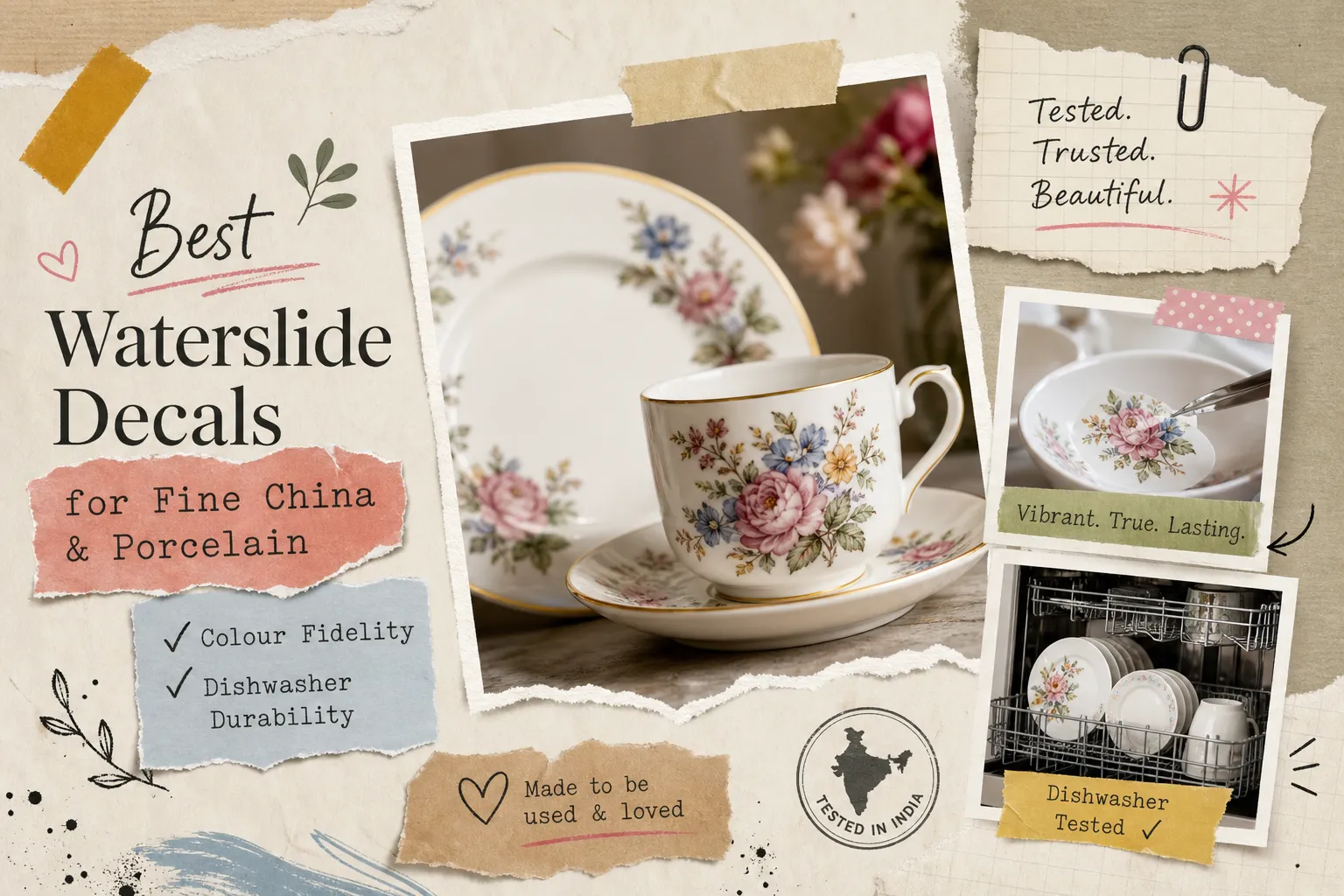
If you have spent any time searching for the best overglaze waterslide decals to buy in India for fine china and porcelain decoration, you already know the frustration. The listings look promising until you read the fine print and realise you are looking at inkjet-printable transfer paper, not kiln-rated ceramic decals. The words "waterslide" and "decal" appear on everything from model kit sheets to candle tattoo film, and none of it belongs anywhere near a kiln. For Indian potters, tableware decorators and hospitality brands, this gap in the domestic market is a frequently encountered problem, one that surfaces across general marketplaces and specialist searches alike.
Running Ceramic Decals India has given me direct, hands-on experience with overglaze decals across fine china, hard-paste porcelain, bone china and hospitality tableware. I have tested firing schedules, evaluated colour fidelity across batches, and seen first-hand what separates a properly formulated ceramic transfer from a generic craft product. That experience is the basis of everything in this article.
What follows covers the full picture: how overglaze waterslide decals are constructed, what evaluation criteria actually matter, where to source genuine kiln-rated options in India, step-by-step application, recommended firing schedules, and how to match the right decal type to your specific use case. By the end, you will know exactly what to look for when buying overglaze waterslide decals for fine china and porcelain, how to apply them correctly, and how to fire them right the first time.
What separates overglaze waterslide decals from other ceramic transfers
How overglaze decals are constructed
A standard overglaze waterslide decal sheet is built in layers. At the base sits a water-soluble paper backing. On top of that, ceramic pigments are printed to form the image. A thin flux layer containing low-melting glass frit sits over the printed colours, and the whole stack is sealed with an organic covercoat lacquer that holds everything together during transfer and burns away cleanly during the kiln firing. The covercoat is the carrier; the flux is what actually fuses the colour to the glaze surface at temperature.
The covercoat burns out during the early, low-temperature stage of the firing, around or below approximately 500°C, leaving only the ceramic pigments bonded to the glaze by the melted flux. Venting the kiln through this phase is non-negotiable: you are burning off organic material, and without ventilation, trapped fumes cause carbon to become embedded beneath the colour layer. "Waterslide" itself describes only the application method, soaking the sheet in water until the image slides free from its backing paper. It says nothing about kiln compatibility or the chemistry of the decal.
Overglaze vs underglaze: which is right for fine china and porcelain
Overglaze decals fire at a much lower temperature than the original glaze firing, typically 820, 860°C depending on the substrate, which means they are applied to ware that is already fully vitrified. This makes them practical for decorating finished pieces without any risk of warping or glaze movement. Underglaze transfers, by contrast, go on before the glaze firing and are sealed permanently beneath the glaze surface, giving them superior abrasion resistance.
The trade-off is colour palette. Underglaze pigments must survive high-fire temperatures, which rules out bright pinks, purples and photographic colour gradients. Overglaze decals have no such restriction: they can reproduce a full-colour photographic gamut, metallic finishes, lustre effects and photorealistic imagery using CMYK and spot-colour ceramic toners. For branded hospitality ware, decorative porcelain and any application where colour accuracy or metallic finishes matter, overglaze is the right choice. For everyday functional tableware that will see very heavy commercial dishwasher use, underglaze transfers offer better long-term durability because the decoration is sealed beneath the glaze rather than sitting on top of it.
How to choose the best overglaze waterslide decals to buy in India
Print resolution and colour fidelity
Resolution determines how cleanly fine lines, small text and photographic gradients reproduce on the fired surface. For fine china and porcelain, 300 DPI at the final decal size is the minimum threshold for near-photographic quality. Prepare artwork at 600 DPI wherever possible, because higher source resolution gives the printer more information to work with, particularly for intricate linework or small-format designs.
Colour fidelity depends on whether the supplier uses Pantone or hex-matched ceramic toners versus a generic CMYK approximation. For branded hospitality ware, this distinction is significant: a café ordering 200 branded espresso cups needs the logo colour to match across re-orders, not drift between batches. Gold and metallic overglaze transfers require a separate liquid gold or lustre layer and fire at a slightly lower peak temperature than standard colour decals. Confirm at the time of ordering whether your supplier can handle both standard and metallic colours in the same production run.
Kiln-firing behaviour and substrate compatibility
Not all overglaze decal sheets are formulated for the same substrate, and firing the wrong decal on the wrong body is one of the most common causes of problems. Decals rated for hard-paste porcelain typically fire at 830, 860°C. Fine china and bone china require a slightly lower range, starting from around 820°C, with bone china firing as low as 750°C for certain precious-metal formulations. Using a porcelain-rated decal on bone china without adjusting the firing schedule risks glaze crazing or colour shift.
After a correct firing, the decal surface should be smooth and flush with the surrounding glaze, with no lifting at the edges and no blistering. Blistering almost always means the covercoat did not fully combust before the kiln reached peak temperature. This happens with poor-quality decal paper or when the kiln ramps too quickly through the 300, 500°C range. A correctly formulated decal on a correctly timed schedule will not blister.
Food safety and dishwasher durability claims
"Non-toxic" and "lead-free" on a product label are not the same as food-contact certification. Genuine food-safe overglaze decals require product-specific migration testing for lead and cadmium on the *finished fired ceramic*, not merely a safety data sheet statement about the raw pigment. In India, the relevant benchmarks are BIS IS 9806, which sets permissible lead and cadmium release limits for ceramic tableware, and the FSSAI Food Safety and Standards (Packaging) Regulations, 2018, which require that food-contact decoration does not transfer contaminants into food.
Gold, platinum and lustre overglaze decals are decorative by default. Unless the supplier provides explicit food-contact migration testing for those specific colours on the fired surface, treat them as exterior-only decoration. Never apply an unverified metallic decal to the rim, lip or inner eating surface of functional tableware. Durability is a separate consideration from food safety: properly fired overglaze decals can reportedly withstand 500, 800 commercial dishwasher cycles, though this performance depends entirely on reaching the correct peak temperature and running a full ramp schedule, consult your supplier's test documentation for specifics. A decal that is underfired may look fine initially and fail within weeks of regular dishwasher use.
Where the Indian market stands and where to actually buy
What general marketplaces actually offer Indian decorators
A search across Amazon India, Ubuy and Desertcart reveals a consistent and unhelpful pattern. Amazon India listings for "waterslide decal" are almost entirely printable transfer paper: inkjet and laser decal sheets from brands like Hayes Paper Co., KOALA, TransOurDream and Printers Jack. These are paper substrates for printing your own designs onto, intended for general craft use, not pre-printed kiln-rated ceramic decal sheets. They have no ceramic toner layer, no flux, and no food-safety documentation relevant to fired dinnerware.
Ubuy India turns up a slightly broader mix, including decorative waterslide designs from FLONZ at around ₹1,483 for a small set, but none of these listings confirm kiln-firing suitability, substrate compatibility or food-contact testing. International specialist brands such as Sanbao Studio and Captive Decals produce genuine overglaze ceramic decals, priced roughly at US$9, 15 for small sets on international platforms, but there are no verified India marketplace listings, no reliable shipping lead times, and no domestic food-safety documentation to support commercial food-service use.
This is the structural problem: the Indian marketplace labels everything "waterslide decal" regardless of whether the product was ever intended for a kiln. The gap between printable craft paper and genuine kiln-rated ceramic transfer decals is wide, and most Indian buyers discover it only after a failed firing.
Ceramic Decals India: the domestic specialist option
Ceramic Decals India is a dedicated domestic ceramic decal printing service, producing custom overglaze and underglaze waterslide decals using professional ceramic toner technology. For buyers evaluating against the criteria above, the key specifications are: full Pantone and hex colour matching for accurate brand reproduction, complimentary digital proofing before production, no minimum order requirement (a single A4 sheet is available at ₹1,000, A3 from ₹2,000), and pan-India dispatch within 3, 5 business days (verify current lead times when ordering, as these can vary by season and production load).
Decals are supplied as lead-free and cadmium-free, with FSSAI-compatible documentation and dishwasher durability specifications available on request, the kind of details that general marketplace listings simply do not provide, because printable transfer paper was never designed to meet them. For Indian potters, hospitality brands and corporate gifting companies who need reliable colour accuracy, food-safety documentation and fast domestic turnaround, Ceramic Decals India is one of the few domestic sources currently meeting these specifications.
How to apply overglaze decals on glazed porcelain
Prep, soak and position
The porcelain must be fully glaze-fired and vitrified before you begin. Wipe the application area thoroughly with a cleaning alcohol, 70, 91% isopropyl alcohol (IPA) as recommended by the decal manufacturer, to remove fingerprints and any surface grease. Oil contamination is the most common cause of lifting during drying or firing, and it is entirely preventable. Allow the surface to dry completely before touching the area again.
Cut closely around each design, leaving as little excess clear film as practical. Soak one decal at a time in lukewarm water for approximately 30 seconds, just until the image begins to slide freely on its paper backing. Do not leave the decal submerged longer than necessary: over-soaking causes the image to separate prematurely and become fragile and difficult to handle.
Once the decal slides freely, keep it face-up on the backing paper and position it on the ceramic surface. Slide the backing paper sideways from underneath the image rather than lifting the decal off it. Make all position adjustments while the surface is still wet, because once the water dries, repositioning will tear the film.
Burnishing, drying and what to check before loading the kiln
Using a soft rubber rib or silicone squeegee, press from the centre of the decal outward toward the edges, working slowly to push out trapped water and air pockets. Use light pressure first, increasing only after the decal lies flat. Blot excess moisture with a clean lint-free cloth. Then check under angled light for any silvery air pockets or lifted edges; a small remaining bubble can be pricked with a fine needle, re-wet with a single drop of water and smoothed flat.
Allow the piece to dry for a minimum of 12, 24 hours before kiln loading. A piece that looks dry on the surface may still have moisture trapped under the film, and loading a damp piece almost invariably causes blistering. Check your decal supplier's instructions, as some formulations allow shorter drying windows. Do not stack decorated pieces during drying, and do not wipe across the decal surface once it is positioned. Before loading the kiln, do a final inspection under angled light to confirm no air pockets or lifted edges remain.
Kiln firing schedules for porcelain and fine china
Recommended temperature ranges
For hard-paste porcelain, fire to 830, 860°C. For fine china and bone china, keep the peak to 820, 835°C to avoid glaze movement or colour burn-out. Bone china in particular can begin to show glaze softening above 835°C, which causes the decal colours to smear or bleed at the edges. Always defer to the decal supplier's stated firing schedule if it differs from these ranges, as different ceramic toner formulations have slightly different flux chemistries.
Do not confuse overglaze decals with high-fire ceramic transfers, which are engineered for 1,175, 1,300°C. Firing a standard overglaze decal to those temperatures will completely destroy the decoration, leaving at best a faint smear on the glaze surface. Gold and metallic overglaze decals sometimes require a slightly lower peak temperature than standard colour decals; confirm this detail with the supplier at the time of ordering.
A practical starting schedule for beginners
Ramp steadily to 500°C with the kiln vented or the bung left open. This is the burnout phase where the covercoat and printing medium combust. Without adequate ventilation, trapped carbon fumes settle beneath the colour layer and produce a grey, hazy appearance on the fired decal. Continue at a controlled ramp of roughly 180, 300°C per hour up to the target peak temperature, then hold briefly at peak to equalise temperature across the kiln load.
Allow the kiln to cool naturally with the lid or door closed. Opening the kiln while the ware is still above 200°C stresses both the porcelain body and the newly fused decal layer. Fine china is particularly sensitive to thermal shock during cooling. Always test-fire a single decorated piece before committing an entire batch. Colour response, gloss level and glaze behaviour vary by kiln, by decal formulation and by the specific glaze on your ware, and a test firing costs far less than a failed production run.
Matching the right decal to your use case
Functional tableware and branded hospitality ware
For espresso cups, latte mugs and serving plates that see daily commercial dishwasher cycles, prioritise overglaze decals with documented food-contact testing and dishwasher durability specifications, not just a "food-safe" label. Ask specifically for a lead and cadmium migration test report referencing the fired ceramic, not the raw material. If the supplier cannot provide this, treat the decals as decorative only.
Branded hospitality ware requires consistent Pantone colour reproduction across re-orders. A supplier who retains your colour profile between orders eliminates the re-matching cost that adds up quickly at commercial scale. The single-sheet minimum at Ceramic Decals India is particularly useful here: prototype on one cup, confirm the colour and finish match your brand standards, then place the full production run with confidence. Depending on production and shipping, the process from first order to approved sample is often achievable within two weeks.
Where to buy the best overglaze waterslide decals for fine china and porcelain
Gold leaf ceramic decals and enamel overglaze transfers are best reserved for decorative ware that will be hand-washed or used for display. The definition and warmth of fired gold overglaze on porcelain is genuinely difficult to replicate through any other method, but food-contact use requires explicit food-contact migration testing for the gold colour specifically, not just for the standard colour decals in the same range. Do not assume that a food-safe certification covering colour decals extends automatically to metallic finishes.
For artistic limited editions, collector ceramics and architectural tile panels, photographic-quality overglaze decal sheets allow full-colour artwork reproduction at a level of detail that hand painting cannot economically achieve at scale. The colour gamut of a properly printed overglaze decal, including deep purples, vivid corals and photographic gradients, is simply not available through any high-fire ceramic decoration method.
How to order custom overglaze decals and request a firing schedule
When ordering from a specialist supplier, share your artwork file in the highest resolution available, specify the substrate (porcelain, bone china, earthenware) and note your kiln's maximum ramp rate. A credible supplier will return a digital proof showing exactly how the colours will reproduce on white ceramic, along with a recommended firing schedule specific to their decal chemistry. Do not accept a generic firing range without substrate-specific guidance.
Ceramic Decals India provides complimentary digital proofing before production and supplies firing guidance alongside each order. Orders are dispatched across India within 3, 5 business days, making it practical to prototype, review and re-order within a normal project timeline. Ask specifically for a food-safety datasheet if the decals will be applied to eating surfaces; a credible supplier will have lead and cadmium-free certification and FSSAI-compatible documentation ready to share without hesitation.
The bottom line on buying overglaze waterslide decals in India
The Indian marketplace is full of printable waterslide paper and short on genuine kiln-rated overglaze waterslide decals for fine china and porcelain decoration, decals with documented colour fidelity, food safety and firing performance. Understanding that distinction before you buy saves wasted material, failed firings and the cost of replacing finished ware. Choosing the best overglaze waterslide decals to buy in India means looking past the "waterslide" label and checking the actual specifications.
Match the decal chemistry to your substrate: porcelain fires at 830, 860°C, fine china and bone china at a lower range. Confirm food-safety documentation for any decal applied to an eating surface. Request Pantone matching for branded work where colour consistency across batches matters. And always test-fire one piece before committing a production batch to the kiln. These are not complicated requirements, but they are the ones most buyers skip until something goes wrong.
For Indian makers and hospitality brands, Ceramic Decals India fills the gap that general marketplaces cannot, combining specialist overglaze printing with no minimum order commitment, domestic pricing and pan-India delivery. The most practical way to evaluate any supplier of overglaze waterslide decals for porcelain and fine china is to run a test. Order a single A4 sheet, request a proof, fire one piece in your own kiln at your own schedule, and assess the result. That is how confident buying decisions are made, and it costs far less than a bulk order of decals that fail in the kiln.