How to choose a supplier for custom ceramic decals with food-safe inks in India
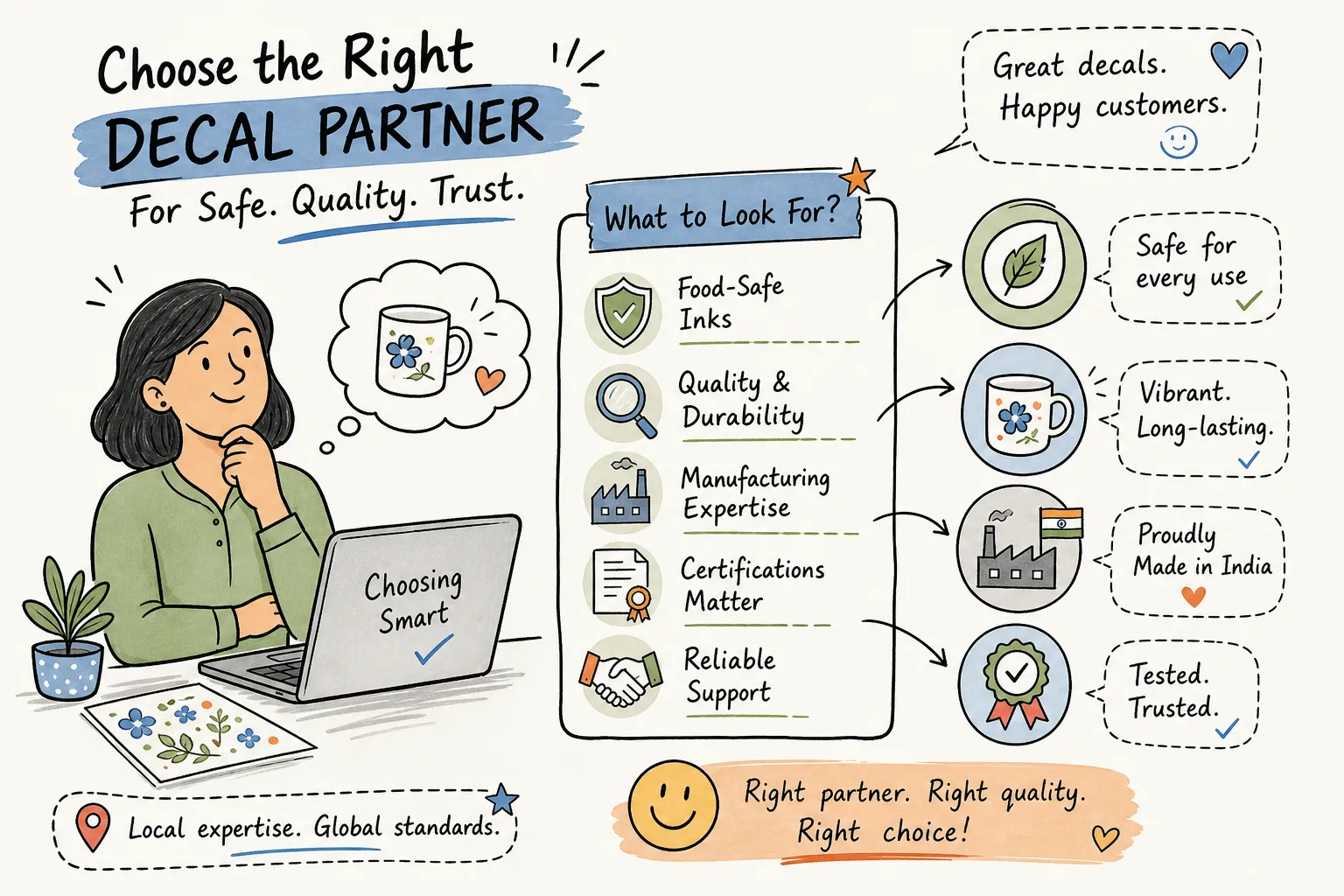
A label that says "food-safe" on a ceramic decal means very little without the right ink chemistry, firing process, and documented test reports to back it up. If you are sourcing custom ceramic transfers for a café, hotel dinnerware programme, or branded gifting project, shortlisting on price alone creates real compliance exposure. Finding the best supplier for high-quality custom ceramic decals with food-safe inks in India requires evaluating ink formulation, firing method, and third-party laboratory documentation, not just price. The wrong decal on a food-contact surface can leach heavy metals into acidic beverages, fade within weeks of commercial dishwashing, or fail an FSSAI inspection entirely.
This guide gives you a working buying framework covering technical standards, compliance documentation, procurement variables, and a pre-order checklist. The goal is a confident, defensible purchase decision. Ceramic Decals India is a dedicated ceramic decal printing service built around these exact criteria, food-safe, kiln-fired waterslide decals with documented compliance and no minimum order. But before we get there, you need to understand what you are actually evaluating.
What "food-safe" actually means for ceramic decals
Food safety in ceramic decal printing is not a single property. It depends on ink chemistry, the firing process, and where the decal sits on the finished ware. A supplier who uses the phrase as a marketing claim without documentation is telling you very little that is useful.
Lead-free and cadmium-free inks: the non-negotiable baseline
FSSAI-compatible ceramic decals must use inorganic pigments free of lead, cadmium, arsenic, and other regulated heavy metals. However, "lead-free pigments" alone are insufficient. The frit, binder, and the full fired article must all pass migration testing before you can claim genuine compliance. Indian Standard IS 9806:2001 is the benchmark for toxic material release from ceramicware used for food and beverage, setting specific migration limits by ware category: for cups and mugs, for example, the permissible lead release is 0.5 mg/L and cadmium is 0.25 mg/L. Those are tight thresholds, and they apply to the finished decorated article, not just the ink as supplied.
Why the kiln-fired waterslide process matters for safety and durability
The kiln-fired waterslide decal process bonds decoration into or onto the glaze at high temperature, creating a chemically stable bond within a glass matrix, a characteristic generally associated with in-glaze and underglaze systems when correctly formulated, fired, and tested on the finished article. Overglaze decals typically fire between 780 and 850°C; in-glaze and underglaze applications go higher, often 1,150 to 1,250°C, sealing the decoration beneath a protective glaze layer. Many lower-temperature or surface-applied methods, pad printing, vinyl, UV-cured inkjet, sublimation, do not fuse into the glaze and may therefore be more susceptible to abrasion, repeated dishwashing, and heavy-metal migration unless specifically tested. For any food-contact application, the firing method is not a minor technical detail: it is the mechanism that determines whether the decoration is actually stable.
Which certifications and test reports are worth requesting from ceramic decal suppliers in India
This is the most overlooked step in supplier shortlisting. Most buyers accept verbal assurances or a generic "FSSAI certified" stamp. Experienced procurement teams request actual laboratory documentation. There is a clear difference between the two.
FSSAI compliance and NABL-accredited laboratory testing
FSSAI compliance for ceramic food-contact ware must be backed by a test report from a NABL-accredited ISO/IEC 17025 laboratory. The report must name the standard tested (IS 9806:2001 or ISO 6486), the food simulant used (typically 4% acetic acid), and the lead and cadmium migration results from the finished fired article. A supplier who offers only an ISO 9001 certificate or a generic compliance stamp, with no laboratory report attached, is a red flag. ISO 9001 is a quality management standard; it does not certify food safety for a specific decorated article.
Migration test reports, heavy-metal release results, and red flags to reject
A complete compliance package should include all of the following:
- A Supplier Declaration of Compliance
- A Statement of Composition covering pigments and frits
- A third-party migration report with overall and specific migration results
- Heavy-metal release figures for at minimum lead and cadmium
Reject documentation that consists only of "non-toxic" or "food-grade" marketing language, an SDS sheet, a pigment certificate without finished-article testing, or migration testing performed on unfired ink. A report without stated detection limits, firing conditions, simulant details, or regulation references is equally worthless. The strongest acceptance criterion is a NABL laboratory report on the actual fired and decorated article, tested under the conditions of intended use.
Colour accuracy, print quality, and firing compatibility
Beyond food safety, the quality of the finished decoration determines whether the product is commercially viable. These factors matter as much as compliance for buyers with branding requirements. The subsections below cover colour matching, decal types, and the failure modes that most commonly derail production.
Full Pantone and RGB matching for branded tableware
For commercial buyers, colour accuracy is not optional. A specialty café's brand colour on a latte cup must match its packaging, signage, and social media assets precisely. Suppliers offering only a generic colour gamut produce results that drift noticeably from specified values, particularly for warm neutrals, deep blues, and brand-specific greens. The difference between a supplier with full Pantone and hex code matching using ceramic toner technology and one using standard overglaze printing can be stark on branded tableware. Digital proofing combined with a test-fired sample on your actual ware is the most reliable way to confirm colour accuracy before committing to a full run. Any supplier unwilling to provide a digital proof is asking you to take an avoidable risk.
Decal type, firing compatibility, and common failure modes to anticipate
Overglaze decals are applied to an already-glazed surface and fired at lower temperatures (780, 850°C), leaving the decoration on top of the glaze. Underglaze decals are applied before glazing and fired at much higher temperatures, sealing the design beneath a protective glaze layer. Both types require precise firing temperature compatibility with the ceramic body and glaze; when that match is off, failure follows predictably. Common failure modes include blistering from trapped moisture in the decal, faded colours from overfiring, poor adhesion from glaze incompatibility, and crazing from thermal expansion mismatch. Always request a test-fired sample on your actual ware before signing off on production. A small investment in a sample run eliminates the most expensive source of rework.
How to choose the best supplier for high-quality custom ceramic decals with food-safe inks in India: procurement factors
Once you have a shortlist of technically qualified suppliers, the practical buying variables determine which one actually works for your project. The key factors to weigh are minimum order quantities, pricing tiers, lead times, and pan-India delivery capability.
How minimum order quantities and pricing tiers work in India
MOQ structures vary considerably across the Indian market. Large screen-print manufacturers typically require 500 to 1,000 pieces per design, which rules them out for prototyping, limited-edition runs, or multi-design orders. Digital ceramic-toner printers can work from a single A4 sheet, making them accessible for sampling and small batches. As a broad market indicator, one specialist supplier lists A4 digital ceramic decal sheets from approximately ₹1,000 for 1, 5 sheets; A3 sheets run around ₹2,000 for 1, 5, reducing to approximately ₹1,800 for 6, 20 sheets and ₹1,500 for 21, 50 sheets, though pricing varies by supplier and artwork complexity, so always request a formal quote. Per-piece cost depends heavily on sheet utilisation: the more efficiently your artwork fills a sheet, the lower your effective unit cost. Artwork complexity, decal type, and number of designs per order also shift the final figure.
Turnarounds and pan-India delivery to factor into project timelines
Realistic timelines for custom ceramic decals in India range from one to three weeks for a prototype or sample, two to four weeks for small batches, and three to six weeks for medium production runs. Artwork approval speed is frequently the biggest variable; delays at the proofing stage cascade directly into dispatch delays. Some high-quality ceramic decal suppliers in India advertise dispatch windows of 3, 5 business days with pan-India delivery coverage, confirm this service level and geographic reach directly with any vendor before committing, as lead times vary. For hospitality and gifting buyers with fixed delivery windows, such as pre-opening hotel projects or seasonal corporate gifting cycles, verifying the dispatch commitment in writing is essential.
Why Ceramic Decals India belongs at the top of your shortlist
Measured against the criteria above, Ceramic Decals India satisfies each requirement, here is how.
No-minimum ordering, food-safe dishwasher-durable decals, and full Pantone matching
The supplier asserts that all decals are lead-free, cadmium-free, and FSSAI-compatible, buyers should request NABL-accredited finished-article migration reports and a Supplier Declaration of Compliance to verify this in writing before placing a production order. The kiln-fired waterslide process is designed for commercial dishwasher durability; request the supplier's laboratory-accredited dishwasher durability report (referencing applicable EN 12875-4/EN 12875-5 or equivalent test methods) to confirm performance under your intended conditions. Pantone and RGB colour matching is offered as standard, and digital proofing before production is included, confirm both in your order confirmation. There is no minimum order: a buyer can order a single A4 sheet to validate a design before scaling. GST-compliant invoicing is available for all business orders, which matters for corporate procurement and accounting teams working within formal purchase approval processes.
How cafés, hotels, and studio potters use the service in practice
A specialty café needing branded espresso cups with an exact Pantone match ordered a single A4 test sheet before committing to production. Colour accuracy was confirmed on the fired piece, and full production followed without rework. A boutique hotel ordering custom dinnerware for a pre-opening deadline used the expedited dispatch option to fit the delivery into a compressed fit-out schedule. A studio potter prototyping a limited-edition collection printed one sheet with multiple small designs, a format that no screen-print supplier in their region would accommodate without a large per-design minimum. These use cases represent the standard commercial and creative scenarios that a no-minimum, fast-dispatch service is built to serve.
A practical pre-order checklist for buyers
Send these eight questions to every supplier you shortlist. A supplier who cannot answer all of them with documented evidence rather than verbal assurances is not ready for a food-contact production brief.
- Are your decals lead-free and cadmium-free, with NABL-accredited migration test reports for the finished fired article?
- Which Indian standard (IS 9806:2001) or international equivalent does your compliance documentation reference?
- What is the exact firing temperature range and decal type (overglaze, in-glaze, underglaze)?
- Can you provide a digital proof and a test-fired sample before production?
- What are your MOQ, pricing tiers, and GST invoicing options?
- What is your typical dispatch timeline and delivery coverage across India?
- Do you offer Pantone or hex code colour matching?
- What are your packaging and breakage policies for pan-India shipments?
A supplier who answers all eight with supporting documentation is qualified for the next stage of your procurement process. A supplier who deflects, generalises, or offers certificates without laboratory reports is not.
Make the right call before you commit to production
The best supplier for food-safe custom ceramic decals in India is not the cheapest option or the most established name. It is the supplier who can hand over actual NABL test reports, show you a fired sample on your specific ware, match your colours precisely, and dispatch within a timeline that fits your project. Those four criteria together are a high bar, and not every ceramic decal supplier in India clears all of them.
Ceramic Decals India is built to meet each of these requirements: food-safe and FSSAI-compatible inks, a kiln-fired waterslide process designed for commercial dishwasher durability (ask for the accredited durability report), full Pantone and RGB colour matching, no minimum order, and pan-India delivery. Compliance documentation, digital proofing, and complimentary design optimisation are standard inclusions, not premium add-ons, request written confirmation of each before placing your order.
The lowest-risk way to start is to order a single A4 sheet with your artwork. It costs very little, it arrives quickly, and it gives you a fired sample to evaluate before you commit to any volume. That one step eliminates the biggest source of risk in the entire buying process. Get in touch with the Ceramic Decals India team to place your first sheet order or to request a production quote.
Frequently asked questions
Which is the best supplier for high-quality custom ceramic decals with food-safe inks in India?
The best supplier is the one who can demonstrate all of the following: NABL-accredited migration test reports on the finished fired article, full Pantone and colour matching, no restrictive minimum order quantities, and a documented dispatch timeline with pan-India delivery. Ceramic Decals India is one supplier that positions itself against each of these criteria, but whichever vendor you evaluate, use the eight-question checklist above and insist on documentation rather than declarations.
- Verify compliance documentation first.Request NABL laboratory reports referencing IS 9806:2001, not generic "food-safe" labels.
- Test before you commit.Order a single fired sample on your actual ware to confirm colour accuracy and adhesion before any production run.
- Confirm logistics in writing.Dispatch timelines, geographic coverage, and breakage policies should be part of your order confirmation, not a verbal promise.